Overview of the Document
Document title:
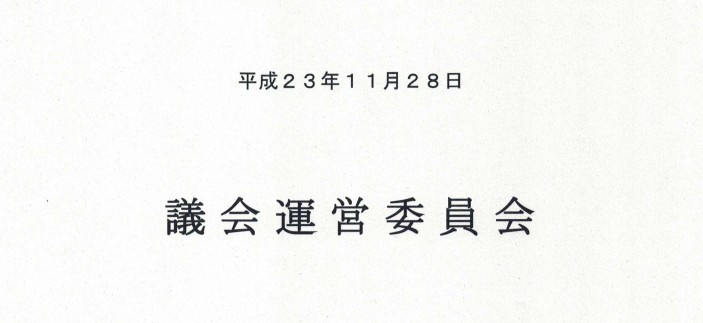
Minutes of the Steering Committee, November 28, 2011 (Heisei 23)
Date created:
November 28, 2011 (Heisei 23)
Created by:
Sukagawa City Council
How obtained:
Obtained through an administrative document disclosure request to the Sukagawa City Council
Type of document:
Minutes of the City Council Steering Committee
Relevant period:
November 28, 2011 (Heisei 23)
Publication format:
Extracted relevant pages from the original Japanese PDF
Original Japanese PDF:
Skip to PDF contentFacts Confirmed by This Document
This document is the minutes of the Sukagawa City Council Steering Committee meeting held on November 28, 2011 (Heisei 23).
The meeting was held as a Steering Committee meeting concerning the operation of the December 2011 regular session of the Sukagawa City Council.
The record shows that Vice Chairperson Morio Atarashi attended the meeting as a non-committee council member.
This fact is significant when examining the involvement of the council leadership in the process leading to the second recommendation for resignation and related documents.
At the beginning of the meeting, the chair referred to the operation of the upcoming December regular session and then addressed the proposed resolution recommending the resignation of Council Member Toshio Tsumuraya.
The chair noted that a prior recommendation for resignation had already been adopted at the end of the September regular session.
The chair then referred to the council-wide meeting held on November 24, 2011 (Heisei 23).
According to the chair’s explanation, based on Mr. Tsumuraya’s words and conduct at that council-wide meeting, although he had stated that he took the previous resolution seriously, the chair could not sense any attitude indicating that he would comply with it.
The chair also stated that Mr. Tsumuraya had made remarks acknowledging drunk driving, and that, in order to make him strongly understand that it was absolutely unacceptable for him to continue serving as a council member, another resolution should be adopted.
The document further records that, at the plenary session scheduled for December 1, 2011 (Heisei 23), Proposed Resolution No. 2 by council members would be placed on the agenda as a resolution recommending the resignation of Council Member Toshio Tsumuraya.
The procedure described in the minutes was as follows: after Mr. Tsumuraya was excluded from the proceedings, the proposer would explain the reasons for the proposal; after that explanation, questions and debate would be omitted; and the resolution would be put to a vote.
The minutes also state that, if the resolution was adopted, the meeting would be suspended, the chair would inform Mr. Tsumuraya in the chair’s room that the resolution had been adopted, and the meeting would then be resumed.
Therefore, this document confirms that the second recommendation for resignation was not handled suddenly or incidentally at the plenary session.
Rather, after the council-wide meeting held on November 24, 2011 (Heisei 23), the Steering Committee on November 28, 2011 (Heisei 23) had already organized the procedural steps: exclusion of the member, explanation of reasons, omission of questions and debate, voting, and notification after adoption.
Important Entries
The most important point in this document is that Mr. Tsumuraya’s explanation at the council-wide meeting on November 24, 2011 (Heisei 23) was connected to the second recommendation for resignation adopted on December 1, 2011 (Heisei 23).
The document does not record the council-wide meeting of November 24 itself.
However, it records how that meeting was treated by the council leadership and the Steering Committee in preparing for the December 1 plenary session.
The chair stated that, based on Mr. Tsumuraya’s words and conduct at the November 24 council-wide meeting, although he had said that he took the prior resolution seriously, the chair could not sense any attitude indicating that he would comply with it.
The chair also stated that Mr. Tsumuraya had made remarks acknowledging drunk driving, and that another resolution should be adopted in order to make him strongly understand that it was absolutely unacceptable for him to continue serving as a council member.
The document then sets out the planned procedure for the December 1 plenary session.
It records that Mr. Tsumuraya would be excluded from the proceedings, that the proposer would explain the reasons for the proposed resolution, and that questions and debate would be omitted before the vote.
This is significant because, at that time, the first criminal trial had not yet begun.
No guilty judgment had been rendered.
Nevertheless, the council was preparing to process another recommendation for resignation based on the member’s explanation at the council-wide meeting and the council’s evaluation of that explanation.
This is significant because, at that time, the first criminal trial had not yet begun.
No guilty judgment had been rendered.
Accordingly, under Article 14, paragraph 2 of the ICCPR and paragraph 30 of Human Rights Committee General Comment No. 32, the planned handling of the second recommendation for resignation raises a direct issue concerning the presumption of innocence and the duty of public authorities not to prejudge the outcome of a criminal trial.
Questions Raised by This Document
1. Under what circumstances was the explanation at the November 24 council-wide meeting given?
This document refers to Mr. Tsumuraya’s words and conduct at the council-wide meeting held on November 24, 2011 (Heisei 23).
However, this document is not the minutes of that council-wide meeting itself.
Therefore, the circumstances under which Mr. Tsumuraya was asked to explain himself must be examined together with other relevant materials and facts.
In particular, it is necessary to examine that he was without counsel, that he was one person facing many other council members, and that he was asked to explain matters that could be disadvantageous to him while a criminal trial was pending.
2. Was it appropriate to use the member’s explanation as a basis for a recommendation for resignation?
This document shows that Mr. Tsumuraya’s words and conduct at the November 24 council-wide meeting were treated as grounds leading toward the second recommendation for resignation.
However, at that time, the first criminal trial had not yet begun.
No guilty judgment had been rendered.
The use of a statement made by a person awaiting criminal trial as a basis for a council resolution recommending resignation raises issues concerning the presumption of innocence, the privilege against self-incrimination, and due process.
3. Was it permissible to negatively evaluate the decision to wait for the outcome of the criminal trial?
In the later second recommendation for resignation, Mr. Tsumuraya’s position that he would wait for the result of the criminal trial before deciding whether to resign was negatively evaluated.
The determination of criminal responsibility belongs to the criminal court.
A person is presumed innocent unless and until proven guilty according to law.
If the presumption of innocence is taken seriously, waiting for the result of the criminal trial is a natural response.
Was it consistent with the presumption of innocence for the City Council to treat that position as a reason for another recommendation for resignation?
4. Was it appropriate to omit questions and debate?
This document records that, at the December 1 plenary session, the proposed resolution would be placed on the agenda, the proposer would explain the reasons, and questions and debate would be omitted before the vote.
A recommendation for resignation may not have binding legal force in form.
However, it can have serious effects on the member’s political position, reputation, social standing, and ability to continue serving as an elected representative.
Was it appropriate, from the standpoint of due process and careful deliberation, to omit questions and debate in such a matter?
5. Was the member’s opportunity to explain or rebut secured when he was to be excluded from the proceedings?
This document records that Mr. Tsumuraya would be excluded from the proceedings before the proposed resolution was handled.
After his exclusion, the proposer’s explanation, omission of questions and debate, and voting were to take place.
This raises the question of whether, and at what stage, Mr. Tsumuraya was given a meaningful opportunity to explain or rebut the allegations and evaluations made against him.
6. Did the City Council prejudge the criminal court’s determination?
This document shows that the City Council was preparing to proceed toward another recommendation for resignation after referring to Mr. Tsumuraya’s explanation at the November 24 council-wide meeting.
At that time, the first criminal trial had not yet been held.
No guilty judgment had been rendered.
The determination of criminal responsibility must be made by a court based on evidence.
For a public body such as a city council to proceed toward a resignation recommendation on the premise that the member had committed drunk driving before the first trial raises the question of whether the council prejudged matters that should have been decided by the judiciary.
Relevant Domestic Law, Treaties, and International Standards
Domestic Law
Article 13 of the Constitution of Japan: The relationship between the recommendation for resignation, the internal council process leading to it, and the individual’s dignity, reputation, social standing, and political position is at issue.
Article 31 of the Constitution of Japan: The guarantee of due process is at issue. The issue is not limited to whether the member had a sufficient opportunity to explain or rebut. It also concerns whether a public body’s pre-judgment evaluation of guilt before a criminal judgment is consistent with due process and the principle of the presumption of innocence.
Article 32 of the Constitution of Japan: The right of access to the courts is at issue. If a public body expresses an evaluation premised on guilt before judgment, and that evaluation spreads through reporting and social perception, it must be examined whether the person’s position to receive a fair judicial determination was adequately protected.
Article 37, paragraph 1 of the Constitution of Japan: The right of a criminal defendant to a fair and public trial by an impartial court is at issue. The issue is whether a fair trial was secured under circumstances in which a public body’s pre-judgment evaluation could have exerted external pressure on the criminal proceedings and judgment.
Article 38, paragraph 1 of the Constitution of Japan: No person shall be compelled to testify against himself. The issue is whether the use of a statement made by a person awaiting criminal trial at a council-wide meeting as a basis for a resignation recommendation is consistent with the purpose of the privilege against self-incrimination.
Article 76, paragraph 3 of the Constitution of Japan: Judges must exercise their conscience independently and are bound only by the Constitution and the laws. The issue is whether a city council, which has no authority to determine criminal responsibility, entered the sphere of judicial determination by proceeding on the premise of criminal conduct before the first trial.
Article 98, paragraph 2 of the Constitution of Japan: Treaties concluded by Japan and established laws of nations must be faithfully observed. This is relevant to Japan’s obligation to faithfully implement the International Covenant on Civil and Political Rights.
Article 99 of the Constitution of Japan: Public officials, including local assembly members, have a duty to respect and uphold the Constitution. The issue is whether a public body’s pre-judgment evaluation premised on guilt is consistent with that duty.
Article 117 of the Local Autonomy Act: The issue concerns the procedural meaning of excluding the member from deliberations and voting on a matter concerning his own status.
Article 336 of the Code of Criminal Procedure: A judgment of not guilty must be rendered when there is no proof of crime. This is related to the principle of the presumption of innocence in criminal proceedings.
International Human Rights Treaty: ICCPR
Article 14, paragraph 1 of the International Covenant on Civil and Political Rights: The right to a fair trial is at issue. If a public body expresses an evaluation premised on guilt before judgment, and that evaluation spreads through reporting and social perception, it must be examined whether the subsequent criminal proceedings and trial sufficiently secured the right to a fair trial.
Article 14, paragraph 2 of the International Covenant on Civil and Political Rights: Everyone charged with a criminal offence has the right to be presumed innocent until proved guilty according to law. The issue is whether the City Council’s pre-judgment evaluation premised on guilt conflicted with the principle of the presumption of innocence.
Article 14, paragraph 3(g) of the International Covenant on Civil and Political Rights: The right not to be compelled to testify against oneself or to confess guilt is at issue. The issue is whether the member’s explanation at the council-wide meeting, given while he was awaiting criminal trial, was later used as a basis for a resignation recommendation in a manner inconsistent with that right.
Standards on Treaty Performance and Interpretation
Article 26 of the Vienna Convention on the Law of Treaties (VCLT): Every treaty in force is binding upon the parties and must be performed in good faith. This is relevant to Japan’s duty to perform the ICCPR in good faith.
Article 27 of the Vienna Convention on the Law of Treaties (VCLT): A party may not invoke its internal law as justification for its failure to perform a treaty. The fact that the matter concerns a local council, internal council procedure, or domestic procedural arrangements does not by itself remove the need to examine the matter under the ICCPR.
Human Rights Committee, General Comment No. 32, paragraph 30: Public authorities have a duty not to prejudge the outcome of a trial or express guilt before a conviction.
Human Rights Committee, General Comment No. 32, paragraph 41: The right not to be compelled to testify against oneself or to confess guilt is relevant to the use of statements made by a person facing criminal proceedings.
The detailed interpretation of these provisions, their application to this case, and their interrelationship are examined in the page on legal arguments and the structure of constitutional and international-law violations.
Relationship to This Case
This document shows how the second recommendation for resignation, adopted on December 1, 2011 (Heisei 23), was scheduled to be handled by the City Council before the plenary session.
This document is not the minutes of the council-wide meeting held on November 24, 2011 (Heisei 23).
However, it shows that Mr. Tsumuraya’s explanation at the November 24 council-wide meeting was connected to the second recommendation for resignation on December 1.
The document states that, based on his words and conduct at the council-wide meeting, although he had said that he took the prior resolution seriously, the chair could not sense any attitude indicating that he would comply with it.
It also states that Mr. Tsumuraya had made remarks acknowledging drunk driving, and that another resolution should be adopted in order to make him strongly understand that it was absolutely unacceptable for him to continue serving as a council member.
The document also records that Vice Chairperson Morio Atarashi attended the Steering Committee meeting as a non-committee council member.
This point is significant because it shows that the internal processing toward the second recommendation for resignation was not limited to the members of the Steering Committee, but proceeded in a setting that included a key officer of the City Council.
The document further records that, at the December 1 plenary session, Mr. Tsumuraya would be excluded from the proceedings; the proposer would explain the reasons for the proposal; questions and debate would be omitted; and the resolution would be put to a vote.
Thus, the second recommendation for resignation was to be processed before the first criminal trial, after Mr. Tsumuraya’s explanation at the council-wide meeting, and through a procedure involving his exclusion, omission of questions and debate, and voting.
This shows that the second recommendation for resignation was not treated incidentally at the plenary session.
Rather, after the council-wide meeting of November 24, the Steering Committee on November 28 had already organized the procedural sequence of exclusion, explanation of reasons, omission of questions and debate, and voting before the resolution was submitted to the plenary session.
In this case, it is necessary to examine how such council procedure can be explained in relation to the presumption of innocence, due process, the privilege against self-incrimination, the fairness of the criminal trial, and the possible prejudgment of judicial matters.
In particular, the document is important for examining the procedural structure of the second recommendation for resignation because Mr. Tsumuraya was awaiting criminal trial, the first trial had not yet been held, no guilty judgment had been rendered, and the council was preparing to exclude him and omit questions and debate.
Related Materials
Related pages
The following core pages are currently available in Japanese only.
Record and Verification of the Case
Record and Verification of the Case, Part 1
Record and Verification of the Case, Part 2
Record and Verification of the Case, Part 3
Record and Verification of the Case, Part 4
Record and Verification of the Case, Part 5
Legal Arguments and Structure of Unconstitutionality and Illegality
Related evidence articles:
Document Distributed in Sukagawa City—Group Calling for the Resignation of Toshio Tsumuraya
Related normative articles:
Related timeline entries:
October 18, 2011:
The alleged incident was said to have occurred.
October 19, 2011:
Toshio Tsumuraya voluntarily appeared at the police station and was then arrested pursuant to an arrest warrant. This was not an arrest in flagrante delicto. Detention began.
October 24, 2011,
Assembly Steering Committee held before the First Resolution Recommending Resignation
October 26, 2011,
First Resolution Recommending Resignation
November 9, 2011:
He was indicted and was later released on bail.
November 28, 2011,
Assembly Steering Committee held before the Second Resolution Recommending Resignation
December 1, 2011,
Second Resolution Recommending Resignation
January 16, 2012,
Conviction
January 31, 2012,
Conviction became final and binding
February 7, 2012,
Assembly Steering Committee held before the Third Resolution Recommending Resignation
February 9, 2012,
Third Resolution Recommending Resignation
February 27, 2012,
Assembly Steering Committee held before the Fourth Resolution Recommending Resignation
March 1, 2012,
Fourth Resolution Recommending Resignation