
Overview of the Document
Document title:
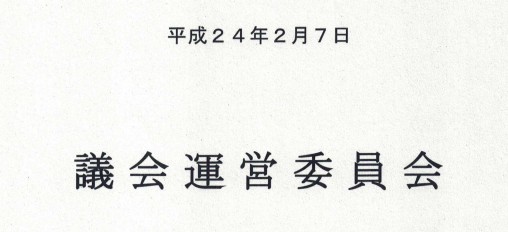
February 7, 2012 Council Steering Committee Minutes
Date created:
February 7, 2012
Created by:
Sukagawa City Council
Source of acquisition:
Obtained through a request for disclosure of information
Type of document:
Council Steering Committee minutes
Relevant period:
February 7, 2012
Format published:
PDF excerpting the relevant portions from the original text
Original PDF:
Skip to PDF contentFacts Confirmed by This Document
This document consists of the minutes of the Sukagawa City Council Steering Committee meeting held on February 7, 2012.
The meeting opened at 1:30 p.m. and closed at 1:56 p.m.
The meeting was held in the Sukagawa City Council committee room.
The committee members present were Hisao Yaginuma, Kunihei Shiota, Yoshihiko Hirose, Kazunori Kato, Tadao Kikuchi, and Kenji Hashimoto.
Chairperson Tadao Suzuki attended as a non-committee member.
The absent committee members were Yasuyoshi Sekine and Masaaki Otera.
The council secretariat staff members present were Mamoru Ichikawa, Secretariat Director; Motohiro Sato, Assistant Director and Proceedings Section Chief; and Sachie Yokokawa, Clerk.
This document records discussions concerning the bills and management of the session for the First Extraordinary Meeting scheduled to be held on February 9, 2012.
In relation to this case, what is important is that the third proposed recommendation for resignation directed at Council Member Toshio Tsumuraya was discussed in advance by the Council Steering Committee.
The chairperson referred to the fact that recommendations for resignation directed at Council Member Toshio Tsumuraya had already been adopted twice, at the September 2011 Regular Meeting and the December 2011 Regular Meeting.
The chairperson then stated, in substance, that Council Member Tsumuraya’s conduct at the all-council-members conference held that morning was extremely regrettable, because far from taking seriously the resolutions previously adopted by the City Council, he had indicated that he would continue to ignore them.
The chairperson also stated, in substance, that each council member had received severe criticism from citizens concerning this issue, that distrust toward the council had arisen, that the matter had been taken up in information magazines and the like, and that the entire City of Sukagawa had been exposed to criticism, creating an extremely concerning situation.
The chairperson stated that he had urged Council Member Tsumuraya to take the previous recommendations for resignation seriously and reconsider, but that Council Member Tsumuraya had indicated that he still had no intention of resigning as a council member.
On that basis, the chairperson explained that, although it would be the third time, the proposed recommendation for resignation was being submitted based on discussions at the caucus representatives’ meeting, where it had been agreed that another recommendation for resignation should be submitted.
The chairperson also stated, in substance, that although such resolutions should not normally be issued repeatedly, this was the utmost response available to the council under the law.
In the explanation of the management of the session, it was further explained that the First Extraordinary Meeting on February 9, 2012 would be held for one day and would open at 10:00 a.m.
It was explained that, as Item 3 on the agenda, Council Member-Submitted Resolution No. 1, “Recommendation for Resignation Directed at Council Member Toshio Tsumuraya,” would be deliberated.
It was explained that this resolution would be treated as an urgent matter and placed as Item 3 because it concerned council personnel matters and should therefore be decided first.
It was also explained that, as on the previous occasion, Council Member Tsumuraya would be asked to leave the chamber, after which Vice-Chairperson Mori would explain the reasons for the proposal, and questions, referral to a committee, and debate would be omitted before the vote.
It was further explained that, after the vote, the meeting would be recessed, the result of the deliberation would be conveyed directly to Council Member Tsumuraya by the chairperson and vice-chairperson in the chairperson’s office, and the meeting would then be resumed with Council Member Tsumuraya asked to return to the chamber.
In addition, the explanation referred to a statement made at the previous December Regular Meeting concerning whether Council Member Tsumuraya would be allowed to participate in votes.
It was explained that, as long as Council Member Tsumuraya remained a council member, obstructing his “right to attend,” “right to speak,” and “right to participate in votes” was not permitted under current law.
The chairpersons and the Council Steering Committee then asked for understanding in order to ensure smooth council management.
Accordingly, this document confirms that the third recommendation for resignation was not something suddenly handled at the plenary session. Rather, at the Council Steering Committee meeting on February 7, 2012, the procedure had already been organized in advance: setting the matter on the agenda as an urgent matter, requiring the person concerned to leave the chamber, having Vice-Chairperson Mori explain the reasons for the proposal, omitting questions, referral to a committee, and debate, proceeding to a vote, and then informing the person concerned of the result after adoption.
Important Entries
What is particularly important in this document is that the third recommendation for resignation, as a recommendation to be made after the judgment became final, was organized in advance by the Council Steering Committee.
The first recommendation for resignation was adopted before indictment, while the person concerned was in detention and absent from the plenary session.
The second recommendation for resignation was adopted before the first hearing and before judgment, after the person concerned had left the chamber.
By contrast, the third recommendation for resignation was scheduled after the guilty judgment and after that judgment had become final.
Therefore, unlike the first and second recommendations, where the issue of pre-judgment public assumptions of guilt was central, the third recommendation raises the issue of the meaning of repeatedly adopting recommendations for resignation even after the judgment had become final.
In this document, the chairperson stated, on the premise that recommendations for resignation had already been adopted twice, that it was extremely regrettable that Council Member Tsumuraya, far from taking those resolutions seriously, had indicated that he would continue to ignore them.
The chairperson also referred to severe criticism from citizens, distrust toward the council, the matter being taken up in information magazines and the like, and concern that the entire City of Sukagawa was being exposed to criticism.
This indicates that the third recommendation for resignation was being considered not only on the basis of the criminal judgment, but also against the background of Council Member Tsumuraya’s failure to respond to the previous recommendations for resignation, public sentiment, distrust toward the council, and social reputation formed through media or information magazines.
It is also important that the Sukagawa City Council itself recognized that recommendations for resignation should not be issued repeatedly.
This document explains that, although this would be the third recommendation for resignation and although such resolutions should not normally be issued repeatedly, it was the utmost response available to the council under the law.
In other words, the third recommendation for resignation was organized in the direction of being submitted even though the council recognized that repeated recommendations for resignation should be approached with caution.
This statement shows that the third recommendation for resignation was not merely an ordinary expression of intent by the council, but a resolution adopted despite the council’s own recognition of the problem of repetition.
This document also explains that, as long as Council Member Tsumuraya remained a council member, obstructing his “right to attend,” “right to speak,” and “right to participate in votes” was not permitted under current law.
This point shows that the Sukagawa City Council recognized that Council Member Tsumuraya still retained his status as a council member and his rights to engage in council activities.
Nevertheless, the council organized its management of the session in the direction of submitting another recommendation for resignation, rather than using a procedure that would legally deprive him of his status as a council member or of his rights to engage in council activities.
Accordingly, this document shows that, even after the judgment became final, the council continued a procedure of repeating recommendations for resignation and applying political and social pressure, while recognizing the existence of Council Member Tsumuraya’s rights as a council member.
Questions Raised by This Document
1. Does the fact that the judgment had become final justify repeated recommendations for resignation?
The third recommendation for resignation, unlike the first and second recommendations, was scheduled after the judgment had become final.
However, the fact that a judgment has become final and the question whether the council may repeatedly adopt recommendations for resignation are not necessarily the same issue.
Even after a criminal judgment has become final, procedures that remove council member status, disciplinary procedures, expulsion procedures, and repeated recommendations for resignation have different legal characteristics.
How can the council’s repeated adoption of recommendations for resignation after the judgment became final be explained in relation to the disadvantage imposed on the person’s political status, honor, personal interests, and council activities?
2. How can a third recommendation for resignation be explained when the council recognized that such resolutions should not be issued repeatedly?
This document states, in substance, that such resolutions should not normally be issued repeatedly.
Nevertheless, the direction was stated that a third recommendation for resignation should be submitted.
If the council itself recognized that repeated recommendations for resignation should be approached cautiously, what necessity, proportionality, and procedural safeguards justified adopting the third recommendation?
3. Was it appropriate to repeat recommendations for resignation while recognizing the existence of the person’s rights as a council member?
This document explains that, as long as Council Member Tsumuraya remained a council member, obstructing his “right to attend,” “right to speak,” and “right to participate in votes” was not permitted under current law.
This shows that the Sukagawa City Council recognized that Council Member Tsumuraya still held the status of a council member and still had rights to engage in council activities.
Nevertheless, the council scheduled a third recommendation for resignation against him.
If the council recognized that it could not legally obstruct his rights as a council member, did repeating non-binding recommendations for resignation and demanding resignation function as substantial pressure to resign or as a substantial sanction?
4. Was it appropriate to repeat recommendations for resignation without using expulsion or other statutory procedures?
Local assemblies have statutory procedures concerning discipline and expulsion in certain circumstances.
However, what is dealt with in this document is not discipline or expulsion, but a recommendation for resignation.
A recommendation for resignation is generally explained as an expression of intent that has no legal binding force.
However, repeatedly adopting recommendations for resignation and continuously demanding resignation as a council can constitute serious political and social pressure on the person concerned.
Does repeating recommendations for resignation, without using statutory disciplinary or expulsion procedures, raise an issue of evading statutory procedures or functioning as a substantial sanction?
5. Was the procedure of requiring the person concerned to leave the chamber and omitting questions, committee referral, and debate appropriate?
This document states that, regarding the third proposed recommendation for resignation, Council Member Tsumuraya would be required to leave the chamber, Vice-Chairperson Mori would explain the reasons for the proposal, and questions, referral to a committee, and debate would be omitted before the vote.
A recommendation for resignation can have serious effects on the person’s political status, honor, social reputation, and council activities.
Was it appropriate, even for the third recommendation for resignation, to omit questions, referral to a committee, and debate from the perspective of careful deliberation by the council and due process?
6. To what extent is it permissible to continue demanding resignation on the basis of distrust toward the council or public sentiment?
This document refers to severe criticism from citizens, distrust toward the council, the matter being taken up in information magazines and the like, and concern that the entire City of Sukagawa was being exposed to criticism.
However, the existence of distrust toward the council or public sentiment is not necessarily the same as a justification for continuing to demand resignation from the person concerned.
To what extent may a city council, as a public authority, repeatedly adopt recommendations for resignation against a council member on the basis of public sentiment or social criticism, in relation to the person’s personal interests, honor, political status, and council activities?
Relevant Laws, Treaties, and International Standards
Domestic Law
Article 13 of the Constitution of Japan:
This provision concerns respect for the individual and personal interests. Even after the judgment became final, the effect of repeated recommendations for resignation on the person’s honor, social reputation, personal interests, and political status remains an issue.
Article 31 of the Constitution of Japan:
This provision concerns the guarantee of due process. Even if recommendations for resignation formally have no legal binding force, if they can have serious effects on the person’s political status, honor, and council activities, the issue is what procedural safeguards were required.
Article 99 of the Constitution of Japan:
This provision concerns the duty of city council members and other public officials to respect and uphold the Constitution. The issue is whether the council’s repetition of recommendations for resignation, while recognizing the existence of the council member’s rights, was consistent with the duty to respect and uphold the Constitution.
Article 117 of the Local Autonomy Act:
This provision provides that a member of the assembly of an ordinary local public entity may not participate in proceedings concerning a matter relating to the personal affairs of the member or certain relatives. The procedural meaning of requiring the person concerned to leave the chamber before deliberating and voting on a recommendation for resignation directed at him becomes an issue.
Article 134 of the Local Autonomy Act:
This provision concerns the power of the assembly of an ordinary local public entity to discipline its members under law and the rules of the assembly. The issue is how the repetition of recommendations for resignation should be positioned in relation to the disciplinary system.
Article 135 of the Local Autonomy Act:
This provision sets out the types of disciplinary measures in an assembly: reprimand in an open session, apology, suspension of attendance for a certain period, and expulsion. The issue is whether repeatedly adopting recommendations for resignation without using statutory disciplinary procedures constitutes a substantial sanction or evasion of statutory procedures.
International Human Rights Treaties: International Covenant on Civil and Political Rights
Article 25 of the International Covenant on Civil and Political Rights:
This provision concerns the right of citizens to take part in public affairs, to be elected, and to have access to public service without unreasonable restrictions. The issue is how repeated recommendations for resignation by the council, a public authority, against a person elected as a council member, and the resulting serious pressure on political status and council activities, should be evaluated in relation to the right of political participation.
Standards Concerning Treaty Performance and Interpretation
Article 26 of the Vienna Convention on the Law of Treaties:
This provision states that every treaty in force is binding upon the parties to it and must be performed by them in good faith. It is relevant to Japan’s obligation to faithfully implement the International Covenant on Civil and Political Rights, which Japan has ratified.
Article 27 of the Vienna Convention on the Law of Treaties:
This provision states that a party may not invoke the provisions of its internal law as justification for its failure to perform a treaty. The issue is whether the relationship with obligations under the International Covenant on Civil and Political Rights can be left unexamined on the ground that the acts were those of a local council, that the matter was internal to the council, or that no specific procedure is provided under the domestic system.
The detailed interpretation of each provision, its application to this case, and the relationship among these provisions are examined in the page “Legal Arguments and Structure of Unconstitutionality and Illegality.”
Relationship to This Case
This document shows what procedures were scheduled by the Council Steering Committee before the third recommendation for resignation was handled at the plenary session on February 9, 2012.
In the timeline of this case, a guilty judgment was rendered on January 16, 2012, and the judgment became final and binding on January 31, 2012.
Therefore, the third recommendation for resignation addressed in this document was a recommendation for resignation after the judgment had become final.
In this respect, the legal issues concerning the third recommendation differ from those concerning the first recommendation, which was adopted before indictment while the person concerned was in detention and absent from the plenary session, and the second recommendation, which was adopted after indictment but before the first hearing and before judgment, after the person concerned had left the chamber.
For the first and second recommendations, the central issues are pre-judgment public assumptions of guilt, the presumption of innocence, due process, the fairness of the trial, and the anticipation of judicial judgment.
By contrast, for the third recommendation, the central issues are the appropriateness, necessity, procedural safeguards, and substantial pressure to resign involved in the council repeating recommendations for resignation after the judgment had become final.
In this document, the chairperson, on the premise that recommendations for resignation had already been adopted twice, treated as problematic the fact that Council Member Tsumuraya had indicated that he still had no intention of resigning, and stated the direction that a third recommendation for resignation should be submitted.
The document also explains that, although such resolutions should not normally be issued repeatedly, this was the utmost response available to the council under the law.
Furthermore, this document explains that, as long as Council Member Tsumuraya remained a council member, obstructing his “right to attend,” “right to speak,” and “right to participate in votes” was not permitted under current law.
This statement shows that the Sukagawa City Council recognized that Council Member Tsumuraya’s status as a council member and his rights as a council member continued to exist.
Nevertheless, the council organized the management of the session in the direction of submitting a third recommendation for resignation, rather than using a procedure that would legally obstruct his rights as a council member.
This document records that, at the First Extraordinary Meeting on February 9, 2012, Council Member-Submitted Resolution No. 1, “Recommendation for Resignation Directed at Council Member Toshio Tsumuraya,” was scheduled to be deliberated as Item 3 on the agenda.
As the procedure, it was scheduled that Council Member Tsumuraya would be required to leave the chamber, Vice-Chairperson Mori would explain the reasons for the proposal, and questions, referral to a committee, and debate would be omitted before the vote.
It was further scheduled that, after the vote, the meeting would be recessed, the result of the deliberation would be conveyed directly to Council Member Tsumuraya by the chairperson and vice-chairperson in the chairperson’s office, and the meeting would then be resumed with Council Member Tsumuraya asked to return to the chamber.
Accordingly, this document shows that the third recommendation for resignation was not handled incidentally at the plenary session. Rather, after the judgment became final, the Council Steering Committee had already organized in advance the procedure by which the matter would be placed on the agenda as an urgent matter, the person concerned would leave the chamber, the reasons for the proposal would be explained, questions, referral to a committee, and debate would be omitted, the vote would be taken, and the result would then be conveyed to the person concerned.
In this case, it is necessary to examine how this kind of council management can be explained in relation to personal rights, honor, political status, rights as a council member, statutory disciplinary procedures, expulsion procedures, and the accumulation of pressure to resign.
Related Materials
Related pages
The following core pages are currently available in Japanese only.
Record and Verification of the Case
Record and Verification of the Case, Part 1
Record and Verification of the Case, Part 2
Record and Verification of the Case, Part 3
Record and Verification of the Case, Part 4
Record and Verification of the Case, Part 5
Legal Arguments and Structure of Unconstitutionality and Illegality
Related timeline:
January 16, 2012:
Guilty judgment
January 31, 2012:
Judgment became final and binding
February 7, 2012:
Council Steering Committee before the third recommendation for resignation
February 9, 2012:
Third recommendation for resignation